

Imagine Knowing the Future of Your Business – Before It Happens
What if you could see customer trends before they hit the market? Predict machine failures before they shut down production? Or tailor marketing messages with near-perfect accuracy, just by analyzing past behavior?
That’s not science fiction. That’s AI predictive analytics, and it’s rapidly transforming how modern businesses operate, make decisions, and compete in a fast-paced world.
In today’s data-driven environment, success isn’t about reacting faster – it’s about anticipating smarter. AI predictive analytics is the compass helping businesses navigate tomorrow’s uncertainty with today’s insights.
Let’s unpack what this powerful technology really is, how it works, and why it’s gaining so much attention right now.
Detailed Table – Biography Format of “AI Predictive Analytics”
| Field | Details |
|---|---|
| Topic Name | AI Predictive Analytics |
| Full Form | Artificial Intelligence Predictive Analytics |
| Definition | A technology that uses AI algorithms and machine learning to forecast future outcomes based on historical data. |
| Main Purpose | To predict future trends, behaviors, and events for better decision-making. |
| Key Components | Data Collection, Data Processing, AI Models, Forecast Algorithms, Dashboards |
| Related Technologies | Machine Learning, Deep Learning, Big Data, Cloud Computing, Neural Networks |
| Popular Tools | IBM Watson, Azure ML, Google Vertex AI, RapidMiner, SAS Analytics, H2O.ai |
| Applications | Finance, Healthcare, Marketing, Retail, Manufacturing, Supply Chain, Cybersecurity |
| Benefits | Improved accuracy, cost efficiency, real-time decisions, customer satisfaction |
| Risks/Challenges | Data privacy, algorithm bias, overfitting, dependency on data quality |
| Data Sources Used | CRM, ERP, IoT Devices, Social Media, Customer Behavior, Market Data |
| Forecasting Techniques | Regression Models, Time Series Analysis, Decision Trees, Neural Networks |
| Industries Leading Adoption | Finance, Healthcare, E-commerce, Insurance, Telecommunications |
| Famous Use Case Examples | Amazon product recommendations, Netflix content suggestions, Stock price prediction |
| Output Type | Predictive Scores, Charts, Forecast Curves, Trend Graphs |
| Time Horizon of Forecasts | Short-term (days), Mid-term (weeks/months), Long-term (years) |
| Real-World Impact | Reduces risk, improves operations, boosts marketing ROI |
| Skillset Needed | Data Science, AI/ML, Python/R, SQL, Domain Expertise |
| Career Opportunities | Predictive Analyst, Data Scientist, AI Engineer, ML Specialist |
| Future Trends | AutoML, Explainable AI, Edge Predictive Analytics, Ethical Forecasting |
| Environmental Impact | Energy use in data centers; new innovations for sustainable AI practices |
| Ethical Considerations | Transparency, Fairness, Bias Mitigation, Data Consent |
| Launch Era | Early 2000s (with rise of Big Data and ML) |
| Current Relevance | Highly trending in 2024–2025 due to GenAI integration and real-time analytics needs |
| Alternatives | Traditional Statistical Analysis, Descriptive Analytics |
| Integration Options | CRM Systems, BI Tools, ERP Platforms, API-based integrations |
| Who Should Use It | Businesses, Analysts, Data Teams, Product Managers, Government Agencies |
What Is AI Predictive Analytics?
At its core, AI predictive analytics is the use of artificial intelligence, machine learning, and statistical modeling to forecast future outcomes based on historical data.
But this isn’t just about running complex equations. It’s about teaching machines to learn from patterns – to understand your data well enough that they can tell you what’s likely to happen next.
This technology goes beyond traditional analytics by adding intelligence. Instead of simply reporting what was, AI predictive analytics tells you what will likely be – and sometimes, even what to do about it.
How Does AI Predictive Analytics Actually Work?
The magic of predictive analytics comes from its layered approach. Here’s a simplified breakdown of how it operates:
Step A: Data Collection
Structured and unstructured data are gathered – customer purchases, sensor logs, website activity, financial records, etc.
Step B: Data Preprocessing
This step involves cleaning, normalizing, and organizing the data. Think of it as teaching the machine what’s relevant.
Step C: Pattern Recognition Using AI Models
This is where the real action happens. Algorithms like regression models, decision trees, neural networks, and deep learning frameworks scan the data to find patterns and correlations.
Step D: Forecasting
The model makes predictions – such as who might churn, when a machine might break down, or how much inventory is needed next month.
Step E: Continuous Learning
AI models adapt over time. The more data they receive, the better their predictions become. They learn, just like humans, but much faster.

Why Businesses Are Turning to Predictive Intelligence
In an era of rapid change and information overload, the ability to make proactive, data-backed decisions is a serious advantage.
Here’s why companies across the globe are embracing predictive tools:
- Anticipate customer behavior (e.g., purchase patterns, churn risk)
- Improve supply chain efficiency (demand forecasting, logistics optimization)
- Prevent system downtime (predictive maintenance)
- Detect and reduce fraud in real time
- Personalize marketing campaigns with precision
- Allocate resources effectively based on future demand
According to recent market data, global investment in AI-powered analytics is skyrocketing. In 2023, the industry was valued at $15.5 billion. Forecasts suggest it could reach between $50 to $70 billion by 2030, with annual growth exceeding 25%.
Also Read: Elmshorner HT/URL
Real-World Examples: Where AI Predictive Analytics Is Making an Impact
Let’s move beyond theory and explore how this technology is playing out in various sectors:
Healthcare
Hospitals are using predictive models to foresee patient deterioration, optimize treatment plans, and reduce hospital readmission rates. In 2024 and 2025, predictive healthcare tools are becoming standard for chronic disease management and personalized care.
Finance
Banks and fintech firms leverage AI models to detect fraudulent transactions and assess credit risk. These systems analyze thousands of data points in milliseconds, making decisions faster – and often more accurately – than humans.
Retail & E-commerce
Companies like Shopify highlight how predictive analytics can drive personalized marketing, forecast demand, and improve customer retention. It’s the engine behind “recommended for you” sections that actually work.
Manufacturing
AI models predict equipment failure before it happens, reducing costly downtime. Predictive maintenance solutions are becoming mainstream in 2025, especially in industrial and logistics-heavy sectors.
Marketing & Sales
Platforms like Mailchimp demonstrate how behavioral data can predict which customers are likely to convert – or leave. Businesses now use these insights to tailor their campaigns and messages in real time.
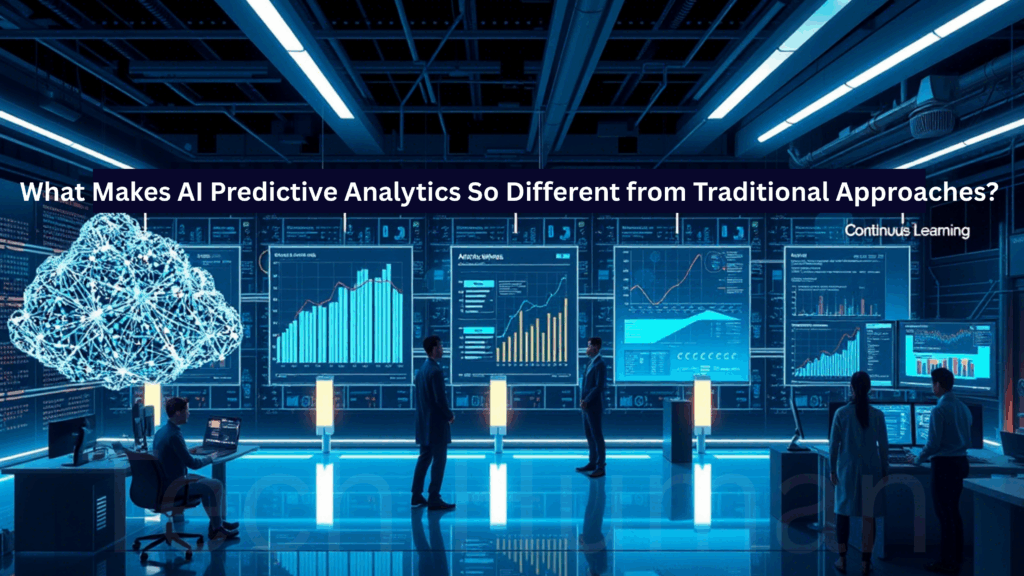
What Makes AI Predictive Analytics So Different from Traditional Approaches?
In traditional predictive analytics, humans define the rules and relationships. But with AI, the system learns those patterns automatically – often finding connections no human would think to look for.
Here’s how they compare:
| Feature | Traditional Predictive Analytics | AI Predictive Analytics |
| Model Building | Manually developed | Machine-learned |
| Speed | Slower, less scalable | Fast and scalable |
| Data Volume | Handles limited datasets | Processes massive data in real time |
| Flexibility | Fixed models | Continuously improving |
| Accuracy | Depends on human design | Improves with experience |
This ability to scale, adapt, and self-improve is what makes AI predictive analytics such a leap forward.
What Are People Asking About AI Predictive Analytics?
Online queries show that people want more than just a definition. They’re asking:
- What is AI predictive analytics with example?
- What’s the difference between AI and predictive analytics?
- What are the best predictive analytics tools today?
- What industries are seeing the biggest impact?
- How does it improve decision-making?
These questions reveal a growing interest not just in understanding the concept – but in adopting it.
Choosing the Right AI Predictive Analytics Platform
If you’re exploring solutions, you’re not alone. The commercial investigation intent around this technology is strong – people are comparing tools, features, and performance.
Top providers include:
- Google Cloud – Strong machine learning integration and scalability
- IBM – Enterprise-grade AI with predictive capabilities
- SAS – Longstanding analytics platform with powerful forecasting tools
- Tableau – Known for visualization, now expanding predictive capabilities
- Domo & Qlik – Business intelligence platforms adding AI prediction layers
- Mailchimp – Excellent for customer behavior prediction in marketing
Before choosing, consider:
- Ease of integration with existing systems
- Scalability for future growth
- Transparency of the AI models
- Data privacy and compliance
- Customization and training options
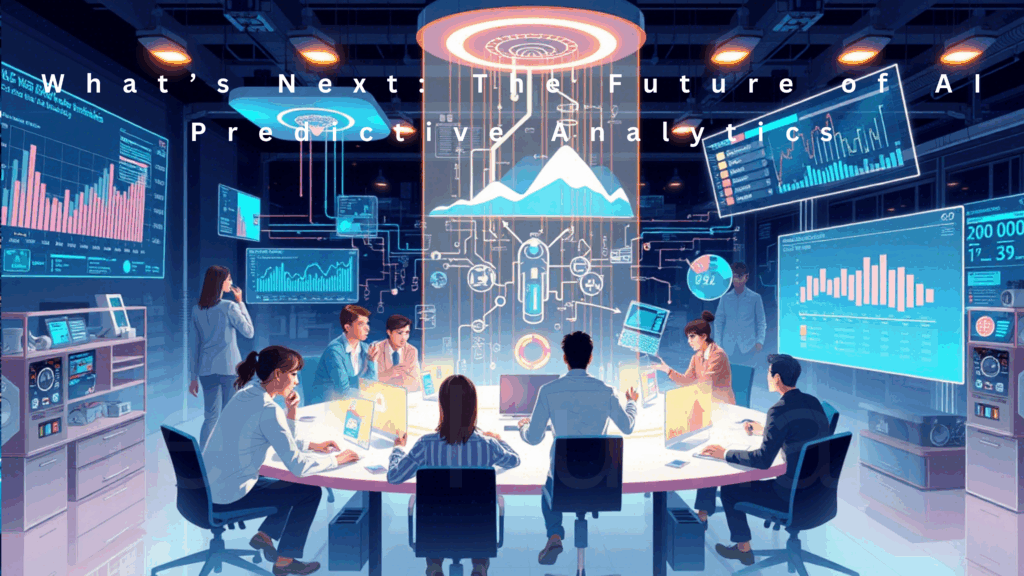
What’s Next: The Future of AI Predictive Analytics
As we move deeper into 2025 and beyond, a few trends stand out:
Real-Time Predictions
With data moving faster, predictive systems are becoming real-time. Decisions are no longer delayed – they happen instantly.
Democratization of AI
Predictive tools are no longer just for data scientists. User-friendly platforms are making advanced forecasting accessible to marketers, product managers, and business leaders.
Hyper-Personalization
Businesses are moving from generalized insights to personalized experiences. AI enables you to serve each customer what they need, before they ask for it.
Ethical Use of Predictive Models
As models gain influence, transparency and fairness become crucial. Companies are investing in explainable AI, data ethics, and bias mitigation.
Final Thoughts: Why This Matters Now
AI predictive analytics isn’t just a trend – it’s a transformation. It’s about shifting from being reactive to being strategically proactive.
Whether you’re running a small business, managing enterprise systems, or launching a new product, the ability to see ahead is no longer optional – it’s essential.
And while the technology may be complex, the value is simple: Better decisions. Smarter operations. Stronger growth.
So the next time you wonder, “What’s coming next?” – just know, with the right data and the right tools, the answer might already be in front of you.
You just need to know where to look.